On January 9, 2026, the United States Bankruptcy Court for the District of Nevada entered a stipulated order discharging $48,493 in federal student-loan debt.
The central finding is direct: this investigation concludes that Bradford Charles Adams of San Francisco used a synthetic Nevada identity and a materially false hardship account to obtain that result.C1-01 · complaint pp. 1–3
The September 20, 2024 adversary complaint identifies the plaintiff as “Bradford Charles Adam,” without the final s, and describes him as a 64-year-old Las Vegas Uber driver. It says he cannot repay the debt because he is the primary caregiver for a wife with stage-four cancer affecting her spinal cord, ribs, hips, nose and throat and because he manages the daily needs of their 14-year-old daughter.C1-02 · complaint p. 4
The records assembled in this investigation challenge that account. Five days after the complaint was filed, the wife and bankruptcy co-debtor published a health update describing four months of treatment for H. pylori, a bacterial infection. Her post referred to stomach cancer as a possible consequence of an untreated infection; it did not describe treatment for metastatic cancer. The evidence also identifies age discrepancies, a name variation in the adversary complaint, the joint debtors' prior bankruptcy filings, and a Nevada identity record extending back to 1993.C1-03 · Sept. 25 post
Four months before the stipulated order, the investigator says he telephoned the office of the Department of Education attorney assigned to the adversary proceeding, Summer Allegra Johnson, supplied the case number and warned that the department was being defrauded through a synthetic identity. The submission states that the matter was routed to a financial-crimes unit and an official identified as Mike Garth. The investigator says he later sent the evidentiary submission, followed up by email and called Johnson's office without receiving a return call. The public docket does not state whether the evidence was reviewed before the Department of Education joined the stipulation.
That identity record leads into the remaining findings. Marriage notices, deeds, tax-exemption declarations, trust instruments, a special power of attorney, gaming proceedings and corporate filings connect the federal filer to Bradford C. Adams in the Carson City records. Those records then lead to AA Gaming, the Carson Nugget, the Hop & Mae Adams Foundation and Carson City redevelopment.
Key findings
- The federal complaint presents a hardship account that a contemporaneous public post places in sharp tension. It alleges stage-four cancer requiring constant care. The wife's public health update five days later described four months of treatment for H. pylori and warned that ignoring symptoms could lead to stomach cancer. The post does not, by itself, medically exclude a separate diagnosis.
- The federal proceeding tracks the Nevada-facing identity profile rather than the subject's California record. The complaint uses the singular surname “Adam,” states an age of 64 and places the plaintiff in Las Vegas. The age and location align with the Nevada-facing profile described in the submission; the singular surname differs from “Adams.” The California record identifies Bradford Charles Adams as age 69 and living in San Francisco.
- The April 2024 filing was a joint Chapter 7 by Bradford and Fatima, and the archive classifies it as Fatima's fourth bankruptcy. The supporting chronology identifies a 1997 Nevada Chapter 7, Fatima Almeida Hein's 2005 Nevada Chapter 7, and the 2015 Florida Chapter 13 of Francisco Almeida and Maria Fatima Almeida before the 2024 joint case.
- The student-loan debt was discharged after the fraud allegation had been reported. The live docket shows that the Department of Education joined a January 9, 2026 stipulation and that the court entered an “Order Discharging Student Loan Debt.” The investigator's submission says the case number and synthetic-identity allegation were first reported to assigned counsel in September 2025.
- 13 stated grounds connect the California and Nevada identity records. They include names, ages, addresses, marriages, property, relatives, businesses, recorded instruments and government proceedings.
- The Nevada identity appears across a much wider company record than three headline entities. Archived profiles and entity records connect Bradford to at least eight named companies and place Alan Adams in a ten-company cluster; the same people, addresses, agents and related entities recur across the Adams family trust, AA Gaming, ABB ATM LLC, Doppelgangers Charitable Corporation and the Carson Nugget network.
- The same limited circle appears in the Carson City redevelopment record. The third finding addresses the Hop & Mae Adams Foundation, Nugget interests, public officials and related professional networks.
I. Bradford Charles Adams
The Bradford evidence is organized around three findings:
- The federal proceeding. The September 2024 complaint used a synthetic identity and a fabricated hardship account to seek discharge of $48,493 in federal student-loan debt.
- The Nevada identity and asset structure. The synthetic Nevada identity was sustained through marriage records, property transfers, trusts, corporate roles, gaming records and a broad power of attorney.
- The Carson City public-private network. The same limited circle appears across the Carson Nugget, related entities, the Hop & Mae Adams Foundation and Carson City redevelopment activity.
Finding 1 — Federal student-loan proceeding and synthetic identity
On September 20, 2024, Bradford Charles Adams filed an adversary proceeding in the District of Nevada seeking to discharge $48,493 in federal student-loan debt as an undue hardship. The complaint states that the loans were incurred while he attended Arizona State University and completed a bachelor's degree in May 2022. It states that he was self-employed as an Uber driver, earned $4,500 a month before expenses, had monthly household expenses of $5,563, and had made approximately five payments totaling about $250.
The stage-four cancer hardship account
Paragraph 21 of the complaint states that the plaintiff is the primary caregiver for a wife with “stage four cancer affecting her spinal cord, ribs, hips, nose, and throat,” that she cannot work and requires constant care, and that he also manages the daily needs of their 14-year-old daughter.
COURT RECORD AND CONTEMPORANEOUS PUBLIC POST
The complaint and the health update, five days apart
“Plaintiff faces undue hardship as the primary caregiver for his wife, who has stage four cancer affecting her spinal cord, ribs, hips, nose, and throat, rendering her unable to work and requiring constant care. Additionally, Plaintiff manages the daily needs of their 14-year-old daughter.”
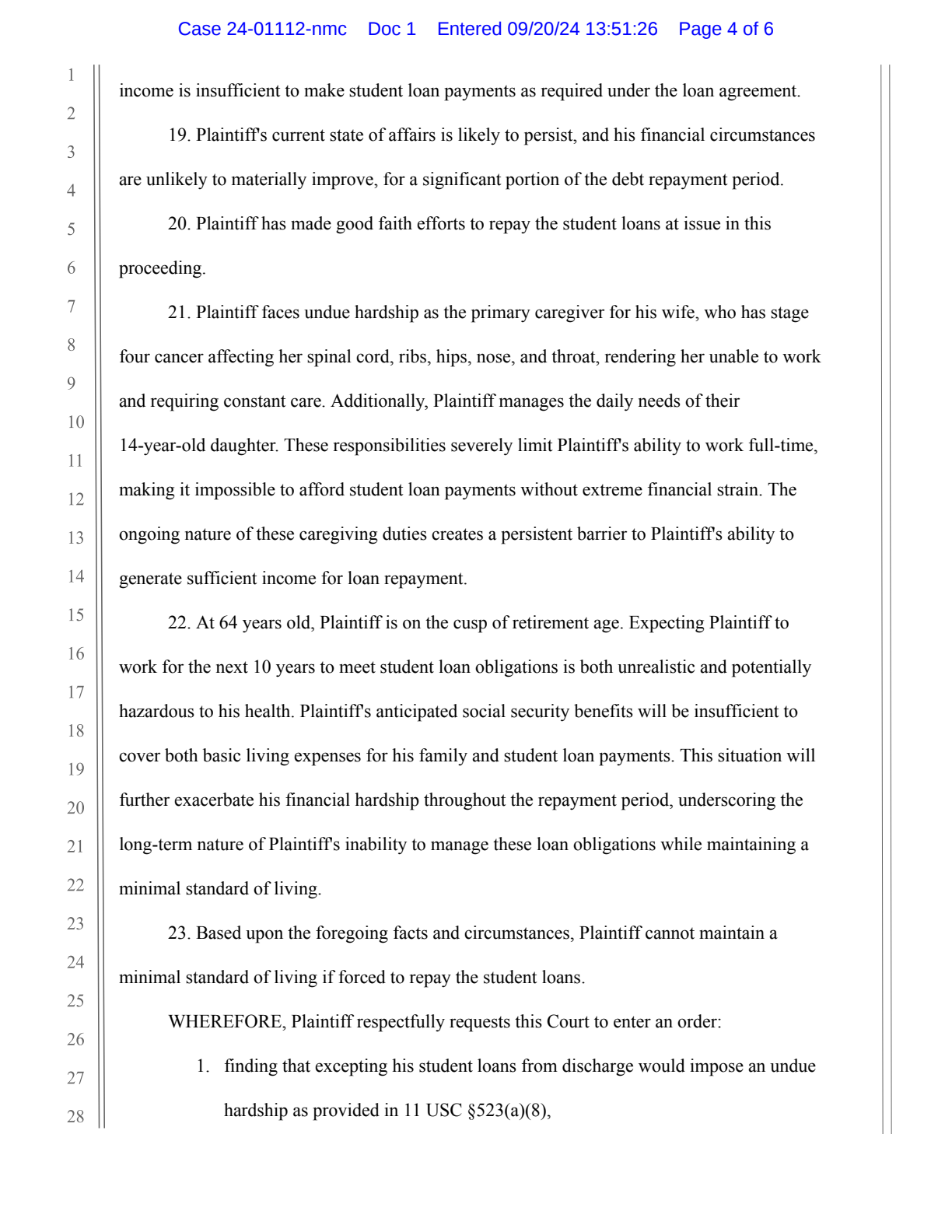
Source: adversary complaint, paragraph 21, PDF page 4 · Archive source id:4rGbu6eiy6wAAAAAAAOaNA
Open the complete court filing
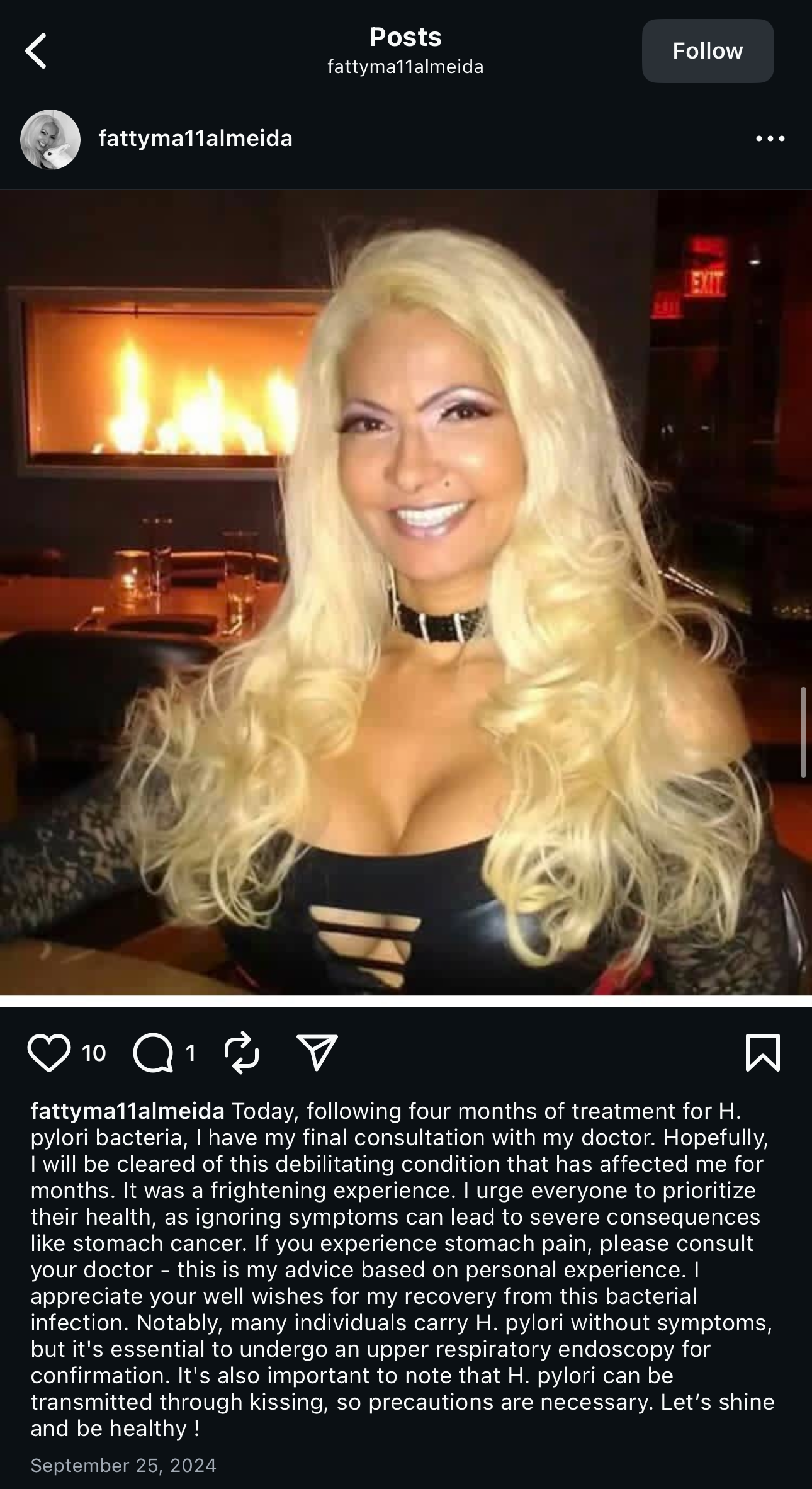
“following four months of treatment for H. pylori bacteria, I have my final consultation with my doctor.”
“ignoring symptoms can lead to severe consequences like stomach cancer.”
Source: archived public post by @fattyma11almeida · September 25, 2024 · Archive source id:4rGbu6eiy6wAAAAAAAPHXw
Open the full archived source image
What the post establishes. The author publicly described four months of H. pylori treatment and a final consultation. She referred to stomach cancer as a possible consequence of leaving symptoms untreated.
What it does not establish. The post does not medically prove that a separate diagnosis was impossible.
Why the timing matters. The public health update appeared five days after the complaint and presents a stark contemporaneous contrast with the stage-four-cancer and constant-care account submitted to the court.
Five days after the complaint was filed, the wife and co-debtor published a public health update stating that she had completed four months of treatment for H. pylori. The post described a final consultation and warned that leaving symptoms untreated could lead to stomach cancer. It did not state that she had stage-four cancer or that she was receiving metastatic-cancer treatment. The post does not medically prove that a separate diagnosis was impossible. Its significance is the stark contemporaneous contrast between the public health update and the stage-four-cancer and constant-care account presented to the court.C1-03 · Sept. 25 post
The age and identity discrepancies
The complaint describes the plaintiff as 64 years old. This investigation identifies Bradford Charles Adams of San Francisco as born in August 1956 and the Nevada-facing profile as born in July 1961. At the filing date, the stated age aligns with the Nevada-facing profile, not the California record. The complaint also uses “Bradford Charles Adam,” while the bankruptcy caption, docket and earlier Nevada records use “Bradford Charles Adams.” The identity discrepancy is therefore the use of the Nevada-facing age, location and biographical profile together with the singular surname—not a claim that the stated age matches neither record.
This investigation uses the term synthetic identity for the Nevada-facing profile because it is supported by a combination of authentic records and disputed biographical attributes. The identity conclusion does not rest on the missing final s or any single database entry. It rests on the cumulative record set described below.
A fourth bankruptcy and the prior cases
Bradford and Fatima filed the April 2024 Chapter 7 jointly. The investigation's archive classifies it as Fatima's fourth bankruptcy. Its chronology identifies the preceding sequence as: Nevada Chapter 7 Case 97-32510, filed October 2, 1997 and discharged January 9, 1998; Fatima Almeida Hein's Nevada Chapter 7 Case 05-51513, filed May 16, 2005 and discharged August 23, 2005; and the Southern District of Florida Chapter 13 filed in 2015 by Francisco Almeida and Maria Fatima Almeida, Case 1:15-bk-10143. The 2024 docket itself carries a “Notice of Debtor's Prior Filing” listing the 1997 and 2005 Nevada cases against the joint-debtor record. The separate 2005 docket names Fatima alone.C1-04 · docket p. 4C1-05 · related cases
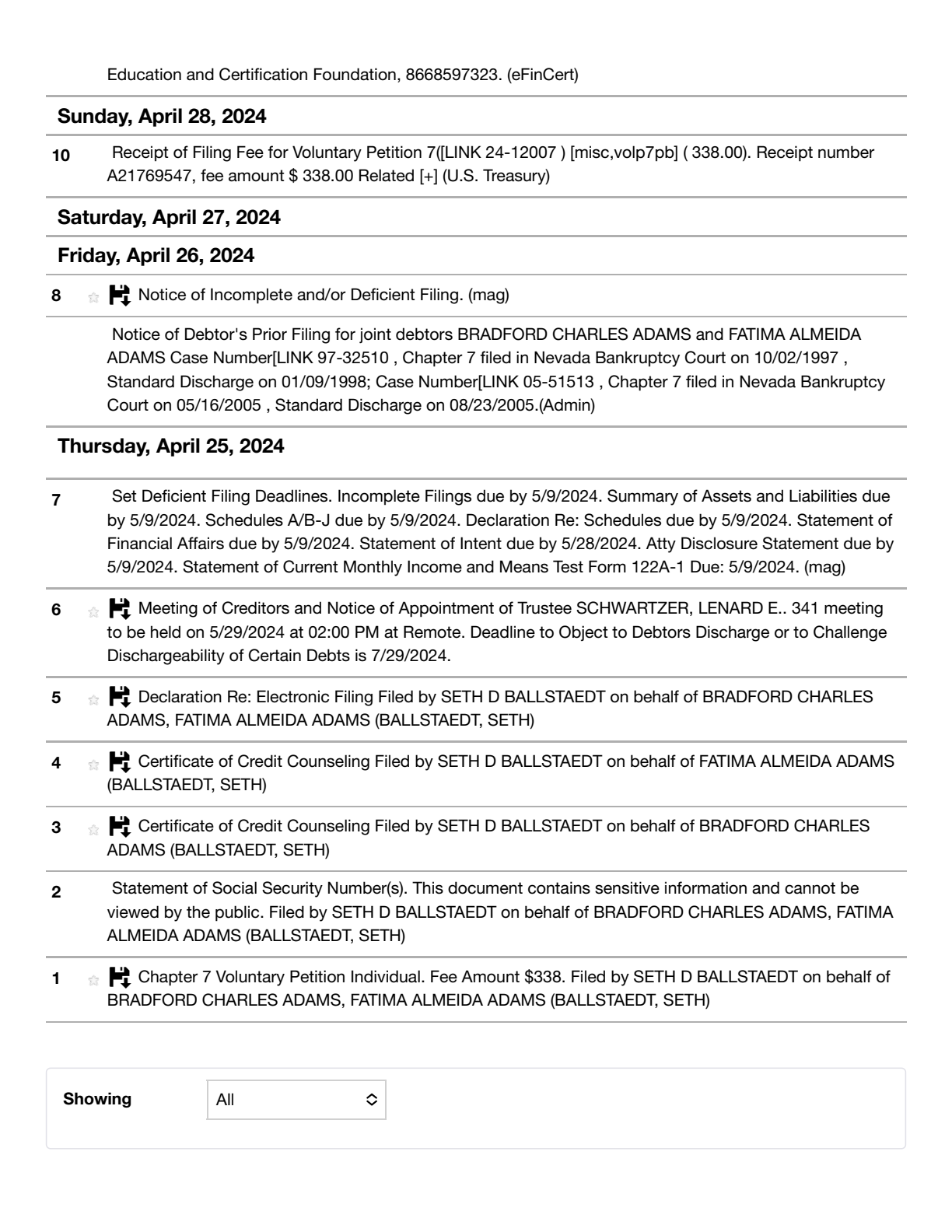
Bradford is unquestionably a named debtor in the 2024 case. The present public source packet does not contain the 1997 case's party sheet, so this publication does not yet attribute that earlier case to Bradford individually. A 2010 Ohio docket for a “Fatima A Adams” is preserved in the archive, but the currently reviewed public extract does not contain enough unique identifiers to count it as the same Fatima. It is excluded from the four-case sequence unless identity is established from the underlying petition.
The zero-real-property schedule and the San Francisco record
The public docket summary for the 2024 Chapter 7 reports $0 in real property on Schedule A/B, $59,837.63 in personal property and $280,614.36 in scheduled claims. The San Francisco recorder archive creates a direct question about that disclosure. A 2011 deed of trust identifies Bradford C. Adams and Ping X. Adams as joint tenants of 1012 De Haro Street, a four-unit San Francisco property. A 2025 San Francisco recorder name-index capture shows no later deed in Bradford's indexed records transferring that parcel, while a city property report lists $1,336,448 in assessed land and structure value. Separate 2020 instruments show Bradford quitclaiming his interest in 1034–1036 Carolina Street to Ping after their divorce.C1-12 · docket p. 3C1-13 · San Francisco property record
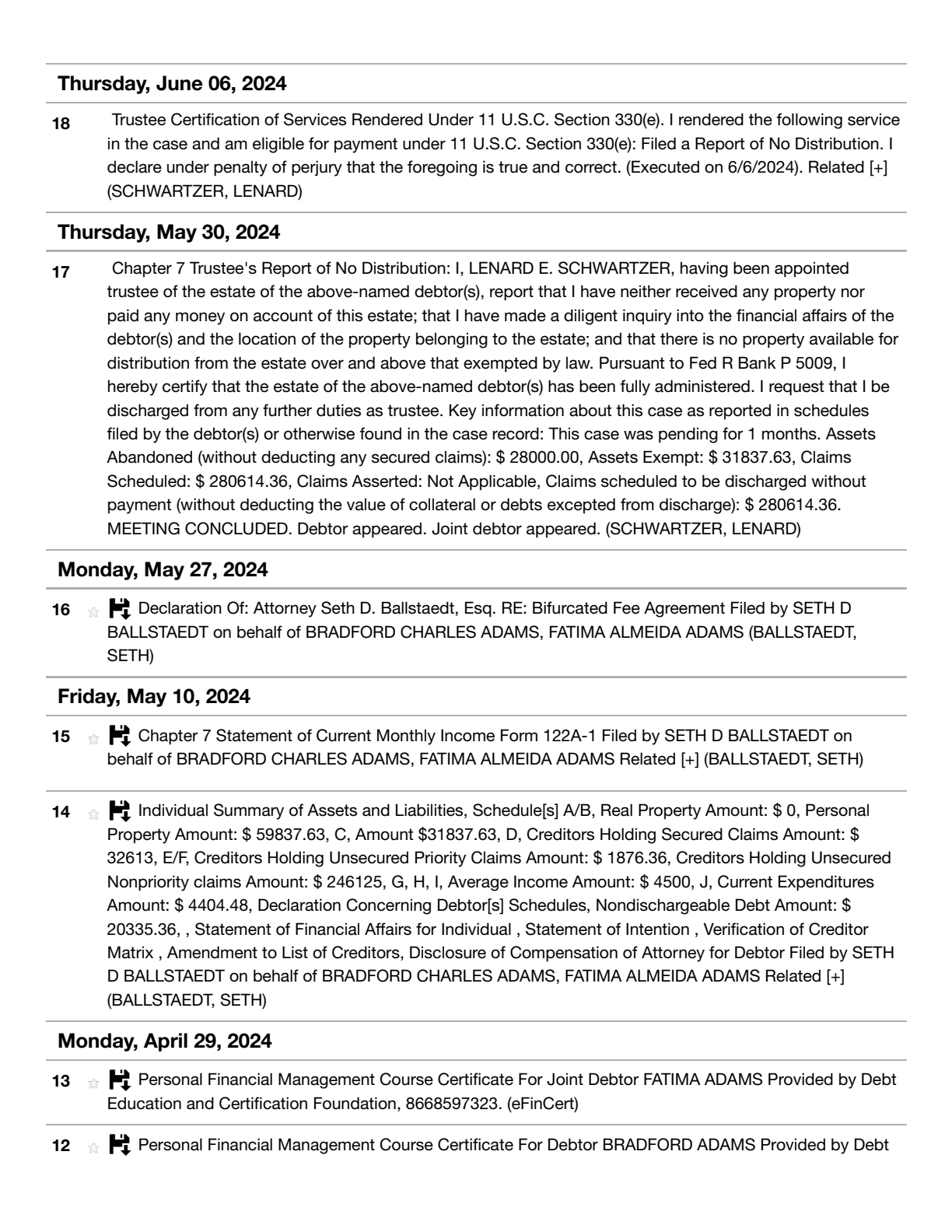
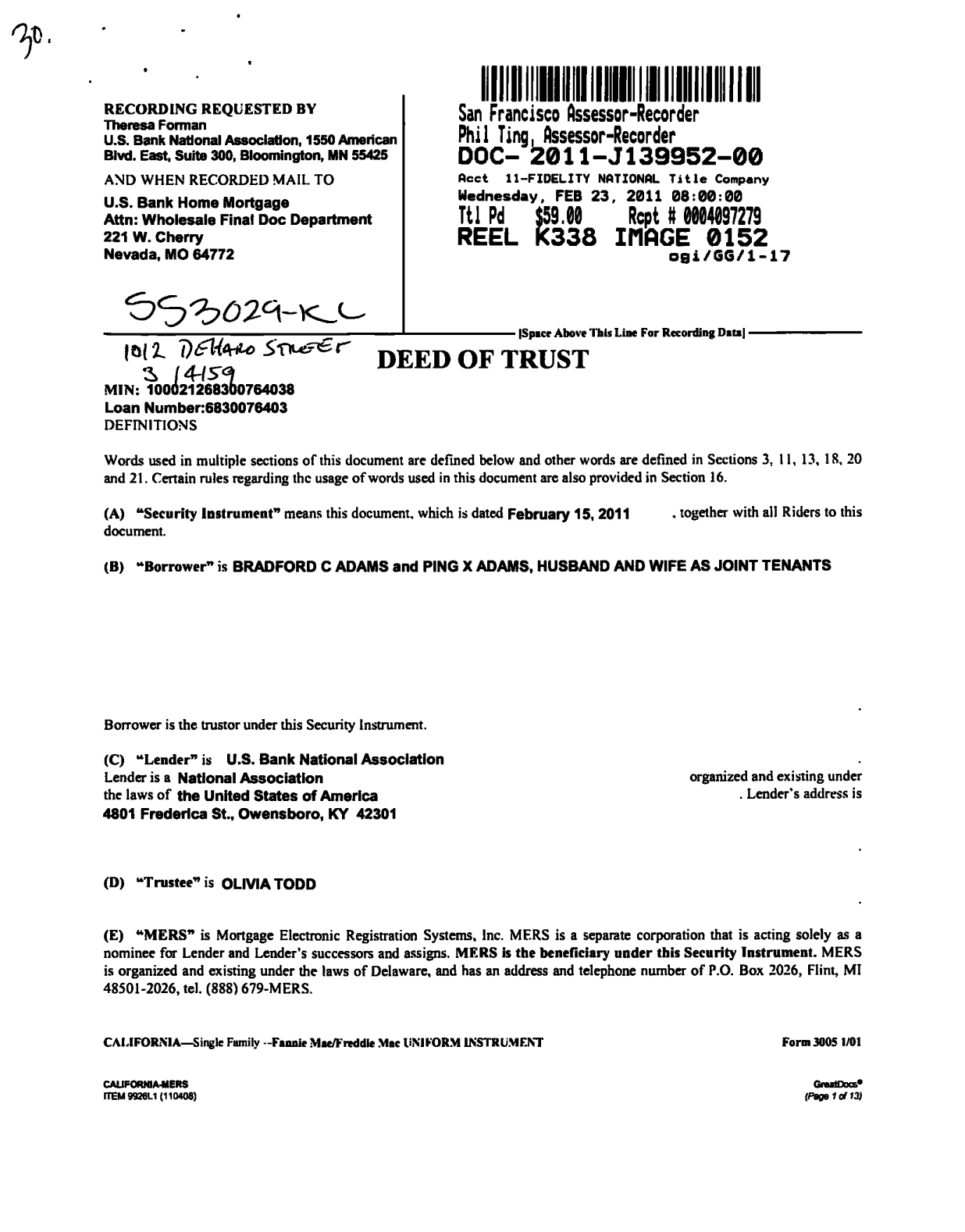
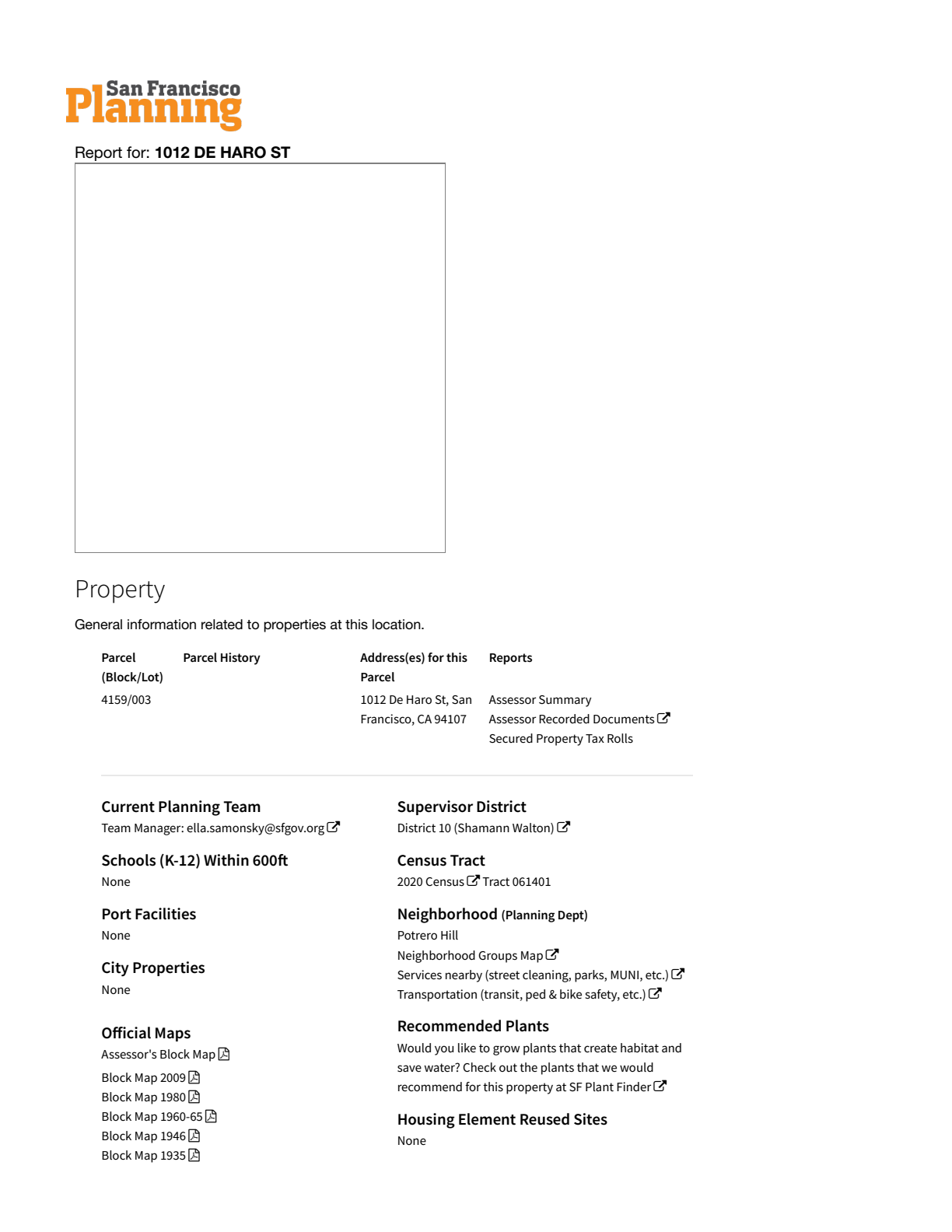
Those records establish Bradford's recorded interest in the De Haro parcel and the bankruptcy docket's zero-real-property entry. Before final publication, the actual 2024 Schedule A/B and a refreshed parcel-title search must be added to determine whether the interest was transferred, exempted, held through another instrument or omitted. Until that comparison is complete, the record supports a specific disclosure question; it does not by itself establish a judicial finding of concealed property.
The discharge and the reporting history
The live adversary docket records the outcome that the earlier archive snapshot did not contain. On January 9, 2026, counsel for the Department of Education filed a stipulation with Bradford Adams. The court entered a stipulated order the same day titled “Order Discharging Student Loan Debt.”C1-07 · live adversary docket
DOCUMENTED SEQUENCE
Report, stipulation and discharge
The formal submission says the investigator gave Summer Allegra Johnson's office the case number and synthetic-identity allegation and was referred to a financial-crimes unit and Mike Garth.
Read source page 16The live docket lists a stipulation filed for the Department of Education and a same-day stipulated order titled “Order Discharging Student Loan Debt.”
Open the live docketThe docket proves the result. The submission documents what the investigator says he reported. Whether federal personnel reviewed the full evidence before agreeing to discharge remains an open reporting question.
The reporting record began before that order. The investigator's formal submission states that he called Summer Allegra Johnson's office in September 2025, provided the case number and described the alleged use of a synthetic identity to defraud the Department of Education. It states that the matter was referred to a financial-crimes unit and to an official identified as Mike Garth, but that no follow-up had been received and no supporting documentation had been requested by the time the submission was completed. A January 2026 email preserved in the private archive repeats that referral history. The investigator says he later sent the evidentiary submission to Johnson, followed up through multiple emails and called her office without receiving a return call. Because the current archive does not contain the underlying call logs or a government acknowledgement of the later submission, those later contacts remain attributed to the investigator pending additional records or a response from the government.C1-06 · submission p. 16C1-07 · live adversary docket
The timing creates a specific reporting question: what information did the Department of Education and any referred financial-crimes personnel receive before the department stipulated to discharge the debt, and what review—if any—occurred? The public docket establishes the stipulation, the order and the closure. It does not answer that question.
13 grounds of identity convergence
The identity conclusion rests on 13 distinct points of convergence, presented in sequence:
Five Carson City records, one continuous name. Property deeds, two marriage records and a recorded power of attorney use Bradford's full middle name and connect the same people across 1993–2008.
Five Carson City records: marriages, deeds and the special power of attorney.
FBI submission PDF page 24 · Read the complete ground
Open the recorded power of attorneyA Nevada parcel inside the California profile. A commercial people-search profile for the San Francisco identity contains parcel and school-district data belonging to the Las Vegas address used by the Nevada-facing profile.
The California-facing commercial profile contains parcel metadata for the Las Vegas address used by the Nevada-facing profile.
FBI submission PDF page 25 · Read the complete ground
Open the implemented identity source mapA documented earlier record. Historical police and court records establish the California subject's full name, birth date and sibling relationship decades before the Nevada profile appeared.
Historical police and court records establish the California subject's name, birth date and sibling relationship before the Nevada profile appeared.
FBI submission PDF page 26 · Read the complete ground
Read the cited records and analysisOverlapping address histories. The two commercial profiles follow one geographic path across California, Nevada and Florida, with overlapping San Francisco business and address data rather than two cleanly separate lives.
Two commercial profiles follow overlapping California, Nevada and Florida address histories and share business infrastructure.
FBI submission PDF page 27 · Read the complete ground
Read the address comparisonTiming across two jurisdictions. Events in the Adams family succession and Bradford's San Francisco property activity occur in the same periods, while public appearances place Bradford and Alan together.
The submission places San Francisco property events beside Adams-family succession events and consecutive public appearances in Carson City.
FBI submission PDF page 29 · Read the complete ground
Read the chronology and cited instrumentsA family precedent for changed names and constructed lineage. Genealogical and historical records cited in the source archive document earlier name and family-history changes that the investigation treats as a methodological precedent.
Genealogical, marriage and newspaper records document earlier name truncation and age discrepancies in the same family line.
FBI submission PDF page 31 · Read the complete ground
Read the lineage recordA 1995 newspaper marriage notice. The Reno Gazette-Journal placed the full name, Carson City residence and an age consistent with the California birth year into a contemporaneous public record.
The 1995 newspaper notice supplies the full name, Carson City residence and an age consistent with the California birth year.
FBI submission PDF page 33 · Read the complete ground
Open the newspaper-record citationPhysical presence in the Nevada nexus. Original photo metadata supplied to the investigation places a family member at a Nevada location associated with the wider record.
Source-supplied photographs and original metadata place a family member at the Nevada nexus described in the submission.
FBI submission PDF page 34 · Read the complete ground
Read the source accountA recurring semantic-obfuscation pattern. The missing final s, narrow name variants and related filing differences recur in contexts where searchability and cross-referenceability matter.
The submission documents recurring narrow name variations and filing differences in records where searchability and cross-referenceability matter.
FBI submission PDF page 34 · Read the complete ground
Read the name-variation analysisEntity cross-contamination. Capital City Electric appears in both public-record profiles through the same San Francisco business address.
Capital City Electric and the same San Francisco business address appear across the two public-record profiles.
FBI submission PDF page 36 · Read the complete ground
Read the entity cross-referenceA visibility cycle. Bradford's Carson City public presence rises during property and business activity and disappears after assets and liabilities move out of the visible record.
Named public appearances rise during Nevada property and business activity and end as assets and operations move out of the visible record.
FBI submission PDF page 38 · Read the complete ground
Read the visibility chronologyDoppelgangers. The entity name used in the gaming and charity records mirrors the double-identity mechanism. This investigation treats the name as contextual evidence, not as a confession.
The entity name Doppelgangers is treated as contextual evidence within the documented double-identity mechanism, not as a standalone admission.
FBI submission PDF page 39 · Read the complete ground
Open the gaming recordMultigenerational Nevada roots and related enforcement records. Genealogical links and government enforcement matters involving collateral relatives are presented as corroborating the investigation's conclusion that the conduct did not arise in isolation.
Genealogical and enforcement records involving collateral relatives are presented as corroborating context for the investigation's conclusion.
FBI submission PDF page 40 · Read the complete ground
Read the cited family and enforcement records
Each ground opens to its supporting discussion and source record. The conclusion rests on the cumulative alignment, not on any one commercial database or inference.
Finding 2 — The documentary record of the Nevada identity
The Nevada record begins long before the bankruptcy.
In November 1993, Bradford Charles Adams married Ping Xiao in Carson City. Over the years that followed, the name appeared in a sequence of Nevada property and business records. Some used addresses connected to the Carson Nugget. Others placed Bradford in transactions with Alan H. Adams, a member of the family that had owned the Nugget since Howard and Mae “Hop” Adams acquired it in 1957.C2-01 · 1993 marriage record
One of the most consequential records is a December 2004 gift deed involving 7140 San Antonio Ranch Road. The accompanying declaration of value described a transfer from Alan H. Adams to “his son Bradford C. Adams” and claimed a Nevada transfer-tax exemption for a transaction within the first degree of consanguinity.C2-03 · gift deed p. 1
The language matters because it did more than move an interest in a property. It placed the two men in a legally declared father-and-son relationship. The investigation found no corresponding public birth record establishing that relationship.
The same pattern appeared again in Carson City. In 2006, Alan H. Adams, as trustee of his family trust, and Bradford C. Adams acquired undivided interests in the Kutcher Manor property. In November 2007, Bradford transferred his half-interest back to Alan's trust. The declaration of value characterized the transaction as “Son to Father.”C2-04 · declaration of value
Those deeds are not presented as stray wording. They are part of the identity record. They placed Bradford inside the Adams family structure in documents recorded with county government and used family status to describe or support the transfers.
Then the assets moved.
In spring 2008, Bradford conveyed 7140 San Antonio Ranch Road and 3784 Paradise View to Larry Goodnight, trustee of the Sunflower Trust. The transactions were accompanied by financing instruments, including an all-inclusive deed of trust and assignment of rents. The same period produced a broad special power of attorney appointing Minden attorney Justin M. Clouser to act for Bradford in real estate, business, tax and government matters.C2-05 · 2008 deedsC2-06 · power of attorney p. 2
The documented sequence is central: Alan places Bradford into title; Bradford transfers a jointly connected property back to Alan's trust; Bradford then conveys other Nevada properties into the Sunflower Trust; and Clouser receives sweeping authority over the estate and its dealings with government.
The documents do not merely show that these people knew one another. They show what each person was authorized to do, which properties changed hands, how the relationships were described, and where control could be exercised.
“The significance of the pattern is not any deed in isolation. It is the cumulative structure the deeds reveal when read in sequence.
Corporate entities, gaming records and 302 N. Carson Street
The most legible public expression of the network appeared at 302 N. Carson Street, part of the Carson Nugget property.
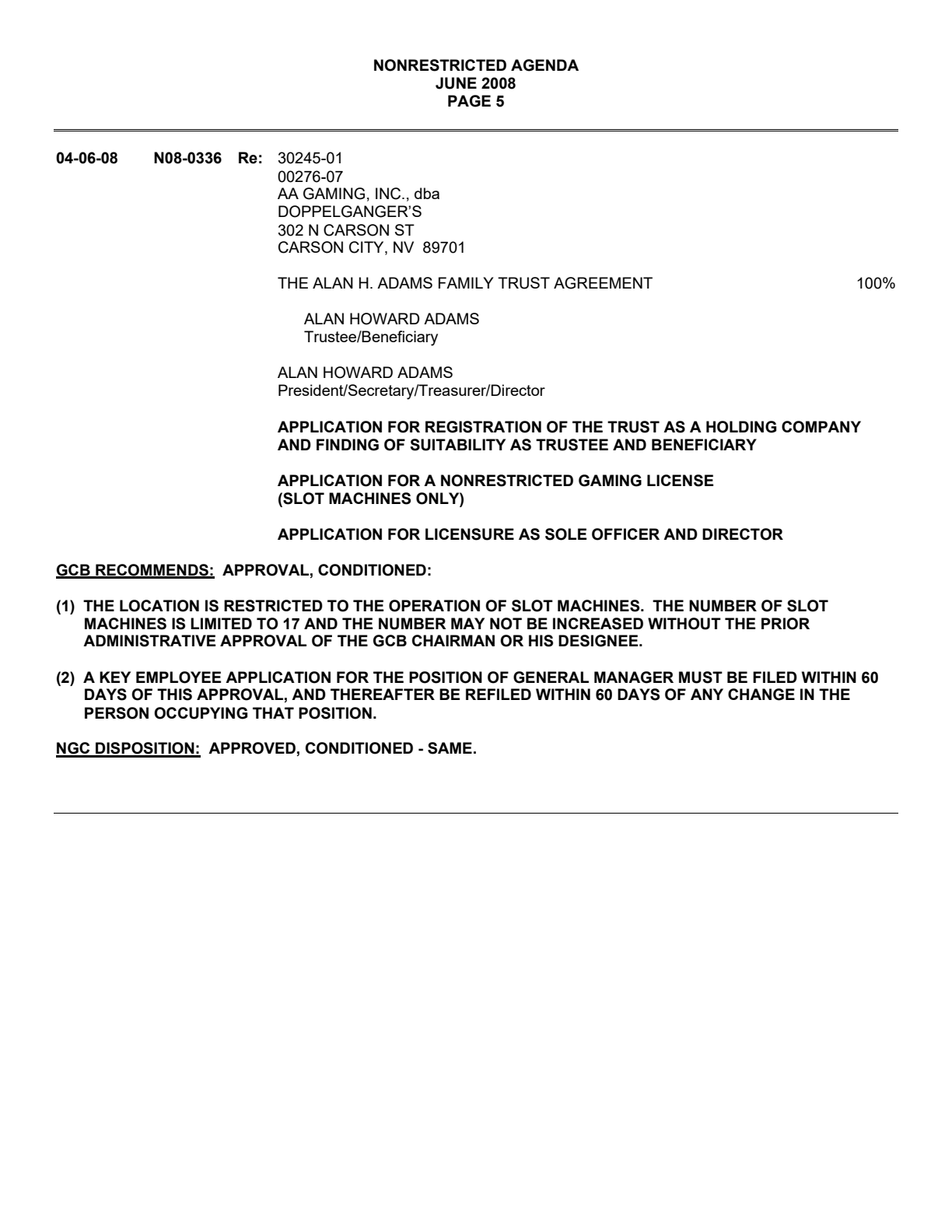
In June 2008, the Nevada Gaming Commission considered AA Gaming Inc., doing business as Doppelganger's, for a restricted gaming license at that address. The commission agenda identified the Alan H. Adams Family Trust as the company's sole shareholder and listed Alan Howard Adams as trustee, beneficiary and corporate officer. The item received conditional approval.C2-07 · gaming record p. 10
Contemporary reporting shows what happened after the bar changed hands.C2-08 · 2012 reports
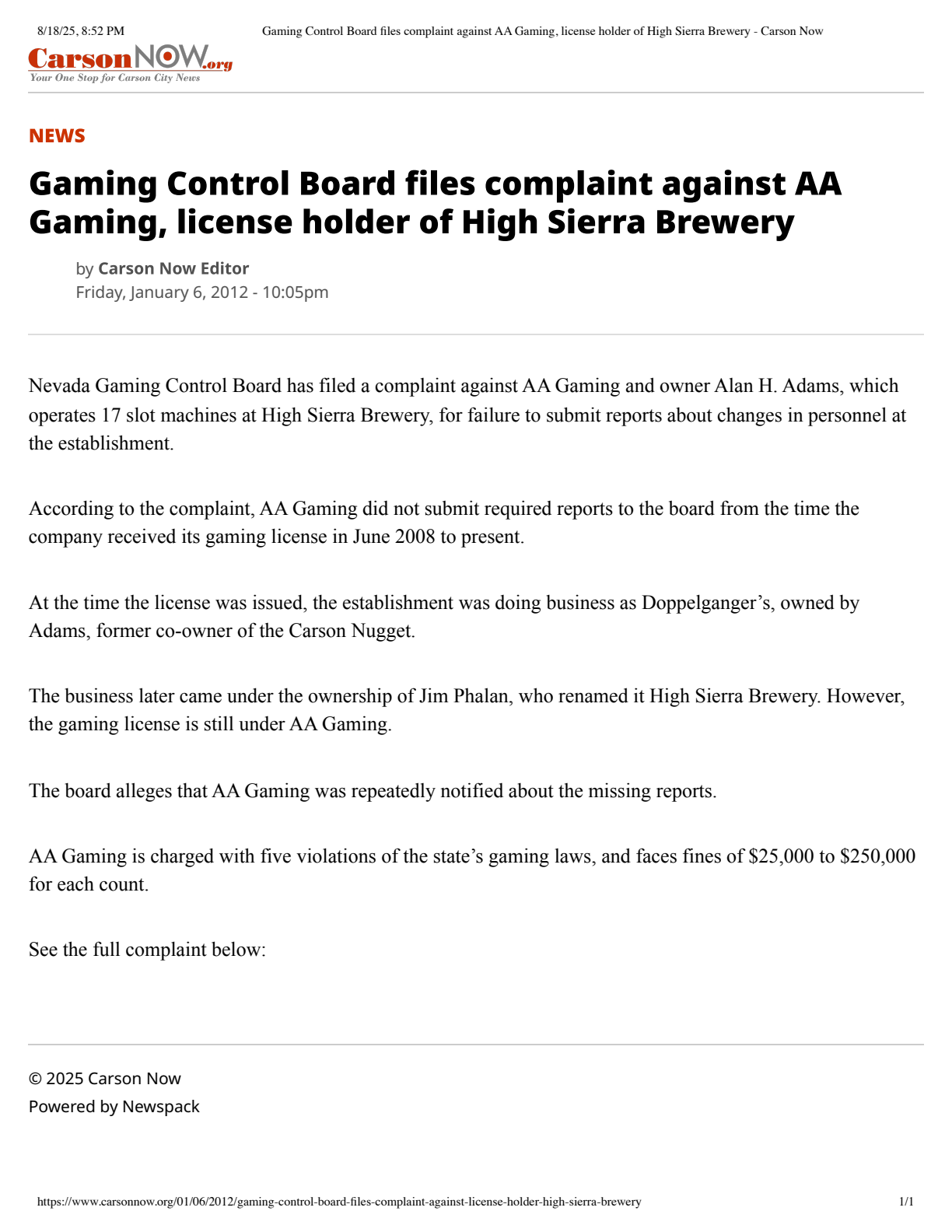
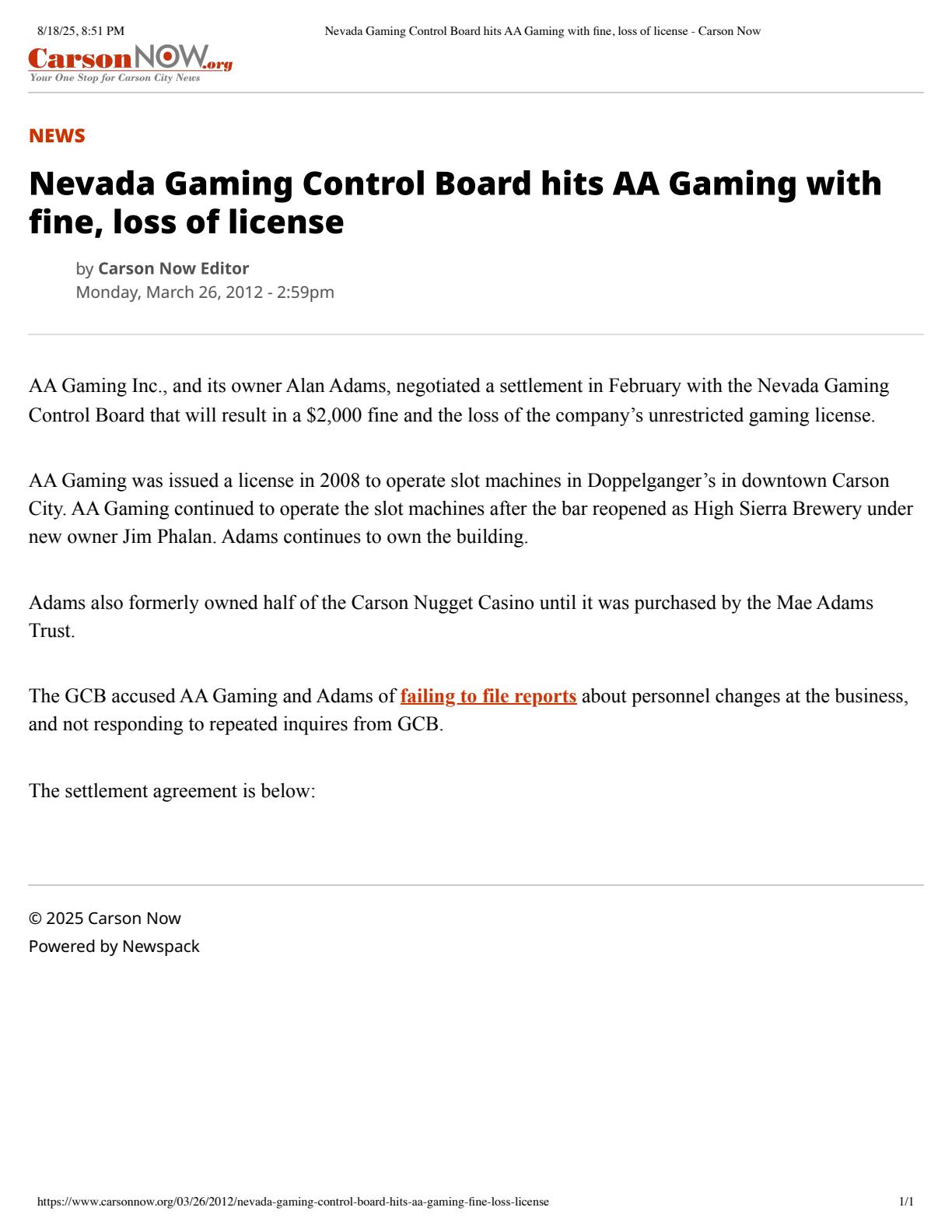
When the venue later reopened as High Sierra Brewing Company, AA Gaming continued to hold the gaming license and operate 17 slot machines there, according to reports on a Gaming Control Board complaint and the resulting settlement. Alan Adams continued to own the building. In March 2012, AA Gaming agreed to pay a $2,000 fine and surrender its unrestricted gaming license after regulators alleged that slot-count reporting and location approvals had not kept pace with the operation.
That episode establishes three roles that must remain distinct: High Sierra ran the bar; AA Gaming held and operated the gaming license; Alan Adams owned the building and controlled AA Gaming through the family trust. Those distinctions clarify the network. They do not make it smaller.
Other records widen it substantially.
The gaming record identifies Alan—not Bradford—as AA Gaming's president, secretary, treasurer and director. Separate entity records place Bradford with Alan Adams and Steven G. Neighbors as listed managers of ABB ATM LLC in 2009, as the Carson Nugget ownership transition was being negotiated. In March 2010, Doppelgangers Charitable Corporation was incorporated with Alan as president, Bradford as secretary, Courtney Hawk-Clouser as treasurer and Justin Clouser—the attorney holding Bradford's special power of attorney—as director. J.M. Clouser & Associates was listed as registered agent.
The entity formation sequence
The archive shows a concentrated sequence of formations and registrations around the 2008 transfer period:C2-11 · NW & BAC2-12 · ConsignmentC2-13 · same-day foreign entitiesC2-14 · B & C Quick Fix
- December 29, 1993 — Zero Defects Software, Inc. The Nevada Secretary of State capture lists Bradford as president and treasurer, with 7140 San Antonio Ranch Road as the officer address and Bradford as registered agent at 1202 N. Carson Street.
- Food Management Services, Inc. An archived entity profile lists Alan as president and director and Bradford as secretary and treasurer.
- May 1, 2008 — NW & BA LLC. The record lists Bradford as managing member and Noel Wygant as registered agent at 800 N. Carson Street.
- May 19, 2008 — Carson City Consignment & Rent-To-Own Center LLC. The record lists Bradford as managing member and organizer.
- May 20, 2008 — C & B Final Touch LLC and C & B Quick Fix LLC. These were separate Delaware entities registered in Nevada on the same day. Archived profiles list the same individual members and Washoe Property Development as a member company. These filings are contextual to the wider network; the selected records do not list Bradford as a member.
- March 20, 2009 — B & C Quick Fix LLC. This was a separate Nevada domestic entity—not the similarly named 2008 foreign C & B Quick Fix LLC. Its record lists Bradford as managing member at P.O. Box 129 in Minden.
- August 25, 2009 — ABB ATM LLC. Archived records list Alan, Bradford and Steven Neighbors as managers.
- March 22, 2010 — Doppelgangers Charitable Corporation. The listed officers and director were Alan, Bradford, Courtney Hawk-Clouser and Justin Clouser; J.M. Clouser & Associates was registered agent.
- June 17, 2011 — DG Airport LLC. The archived entity profile lists Bradford as a member and connects the record to the same company cluster.
ENTITY RECORD
A dated index of the selected company filings
Each name remains a separate legal entity. Role labels reproduce the selected state record or archived public-record profile.
| Date | Entity | Documented role or relationship |
|---|---|---|
| 1993 | Zero Defects Software, Inc. | Bradford — president and treasurer |
| Archived record | Food Management Services, Inc. | Alan — president/director; Bradford — secretary/treasurer |
| May 1, 2008 | NW & BA LLC | Bradford — managing member |
| May 19, 2008 | Carson City Consignment & Rent-To-Own Center LLC | Bradford — managing member/organizer |
| May 20, 2008 | C & B Final Touch LLC | Foreign entity; same members and member company as the next filing |
| May 20, 2008 | C & B Quick Fix LLC | Separate foreign entity; contextual link, no Bradford role in selected record |
| Mar. 20, 2009 | B & C Quick Fix LLC | Separate Nevada entity; Bradford — managing member |
| Aug. 25, 2009 | ABB ATM LLC | Alan, Bradford and Steven Neighbors — listed managers |
| Mar. 22, 2010 | Doppelgangers Charitable Corporation | Alan, Bradford, Courtney Hawk-Clouser and Justin Clouser — listed roles |
| June 17, 2011 | DG Airport LLC | Bradford — listed member |
The distinction between the two Quick Fix names is important. C & B Quick Fix LLC was a Delaware entity registered in Nevada in May 2008. B & C Quick Fix LLC was a Nevada entity formed in March 2009 and listed Bradford as managing member. Similar names are part of the investigative context; they are not a basis for collapsing two legal entities into one.
The wider company network
The archived Bradford Adams people profile contains ten role rows across eight unique entities: Food Management Services, DG Airport, Doppelgangers Charitable Corporation, B & C Quick Fix, Zero Defects Software, F&B Transportation, Carson City Consignment & Rent-To-Own Center, and NW & BA. The profile lists two roles at both Food Management and Zero Defects, which explains why ten rows represent eight companies.C2-17 · Bradford entity-role index
An archived Alan Adams profile reports associations with ten inactive companies and says his highest company overlap was with Bradford. The visible company set includes Doppelgangers Charitable Corporation, Food Management Services, AA Gaming, The Magic of Curtis Adams, AA Storage, 302 N Carson LLC, ABB ATM, BMB Toads, DG II and Tanwba. That profile is an archived public-record index, not a substitute for each underlying state filing; the relationship graph labels those edges as archived associations for that reason.C2-18 · Alan ten-company index
The FBI submission characterizes Doppelgangers and related companies as shell entities used to shift assets, debt and control. The selected entity records independently establish names, dates, officers, managers, agents and addresses. Those filings do not, standing alone, establish that every listed company lacked a legitimate business purpose or that every entity was used unlawfully. The investigation's shell-company conclusion rests on the filings read together with the property, trust, gaming and bankruptcy sequence.
The result is not a single ambiguous corporate edge. It is a set of typed relationships:
- Alan Adams: building owner, family-trust trustee and beneficiary, AA Gaming officer, listed principal of Food Management and participant in the archived ten-company cluster.
- Bradford Adams: property transferee and transferor, asserted family member in recorded deeds, listed officer or manager across the eight-company profile, and participant in ABB ATM and Doppelgangers Charitable Corporation.
- Justin Clouser: attorney-in-fact with authority over Bradford's estate and government affairs, director of Doppelgangers Charitable Corporation and part of the registered-agent firm named in the entity record.
- Courtney Hawk-Clouser: treasurer of Doppelgangers Charitable Corporation and a principal at the same Minden address used by the registered agent.
- Steven Neighbors: Carson Nugget figure, guardian of Alan's estate, foundation trustee and listed co-manager of ABB ATM.
RELATIONSHIP INDEX
People, entities and the records connecting them
Each row identifies the type of relationship and the source that establishes it.
2004 gift deed; 2006 acquisition; 2007 transfer
May 6, 2008 power of attorney
Nevada Secretary of State capture; 1993 formation and later officer history
Archived entity profile
May 1, 2008 entity record
May 19, 2008 entity record
March 20, 2009 Nevada entity record; separate from the 2008 foreign entity
June 17, 2011 entity record
Nevada Gaming Commission record, source page 10
August 25, 2009 entity record
March 22, 2010 Nevada entity record
March 22, 2010 Nevada entity record
Separate Delaware entities registered in Nevada on May 20, 2008
2008 gaming record; 2012 complaint and settlement reporting
January 6, 2011 land-transfer report
2010 structure account and 2011 transfer report
Nugget Project reporting and Foundation returns
September 15, 2011 Carson Now report
2011 Board-vote report and May 17, 2012 Carson Now report
February 28, 2025 GovMarketNews report
February 28, 2025 GovMarketNews report
2020 and 2023 Foundation returns
Directory pages 13 and 16–17; directory listing does not establish misconduct
Finding 3 — The Hop & Mae Adams Foundation and Carson City redevelopment
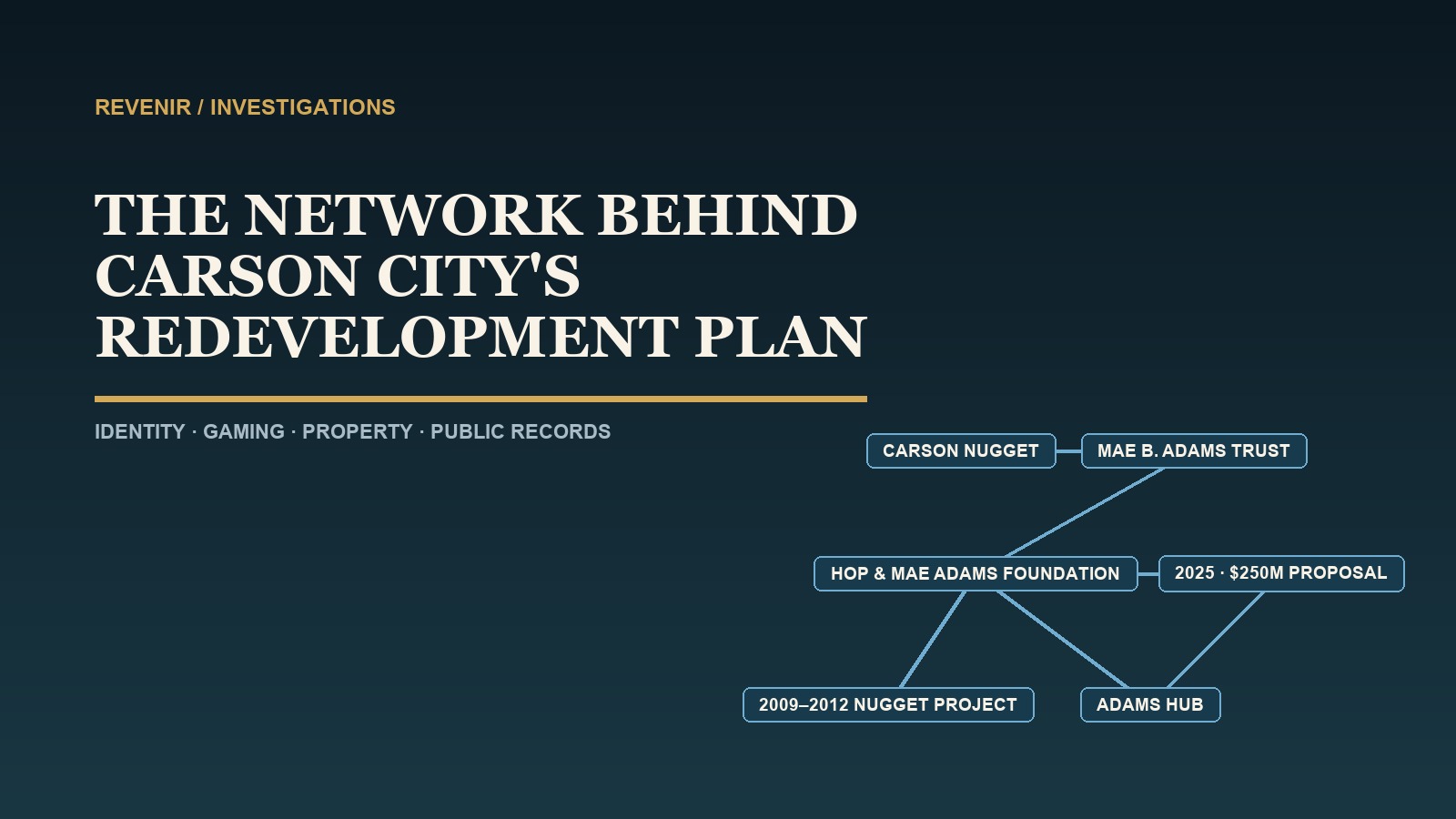
The third finding follows a documented institutional chain from the Carson Nugget and the Mae B. Adams Trust to the Hop & Mae Adams Foundation, then into two different downtown redevelopment efforts separated by more than a decade. The 2009–2012 Carson City Center/Nugget Project and the 2025 $250 million proposal are distinct projects. The connection between them is the Foundation and the downtown property and development infrastructure assembled around it.C3-01 · 2010 Nugget structureC3-02 · 2025 proposal
TWO PROJECTS · ONE DOCUMENTED INSTITUTIONAL LINE
The Nugget-era structure and the 2025 proposal
The records do not describe one uninterrupted $250 million project. They describe an earlier Nugget Project, later Foundation-funded development programs and a separate $250 million proposal announced in 2025.
Carson City Center / Nugget Project
- Carson NuggetOperated the casino and owned the proposed development land.
- Mae B. Adams TrustAcquired the Nugget ownership interests; a 2011 report documented transfer of project land from Carson Nugget Inc. to the trust.
- Hop & Mae Adams FoundationWas intended to receive and lease development land; later described as contributing up to $8 million, then $5 million for a garage.
- Carson City Board of SupervisorsVoted 4–1 to advance the $49 million plan with stated city funding and later pursued a quarter-cent sales-tax ballot question.
$250 million downtown plan
- Hop & Mae Adams Foundation + Adams HubNamed with Carson City as partners in the multiphase proposal.
- Public componentsNew city hall and parking garage proposed for Carson City and/or Nevada funding.
- Private componentsConference center, hotels, housing and other development, with about $200 million in later private investment anticipated.
- Proposed CCDCA new development corporation contemplated to receive city, state and Foundation parcels and handle the community portion of the early phases.
In February 2010, Nugget president Steve Neighbors publicly described the structure. The Carson Nugget operated the casino and owned the proposed development land. The Mae B. Adams Trust had acquired the ownership interests in the Nugget. Once the necessary parcels were identified, the plan was for the Nugget to transfer the land to the Hop & Mae Adams Foundation, which would lease it for the development and return lease proceeds to the community. In January 2011, reporting documented an initial transfer from Carson Nugget Inc. to the Mae B. Adams Trust in advance of a Board of Supervisors decision.C3-01 · 2010 Nugget structureC3-03 · 2011 land transfer
The public-finance terms then changed. In September 2011, the Board voted 4–1 to advance a $49 million project. The reported package included $11.3 million in city redevelopment funds, $12 million from increased landfill fees and $500,000 from the city utility fund, conditioned on $21 million in private funds and grants. Neighbors said the Foundation could contribute up to $8 million. When the proposed private financing proved unworkable, the Board moved in May 2012 toward a quarter-cent sales-tax ballot question. Neighbors separately committed $5 million from the Foundation for a parking garage; the city manager and Neighbors said the garage was not required for the public plaza or knowledge center but that the lack of parking would hurt the casino.C3-04 · 2011 Board voteC3-05 · 2012 ballot and garage
The Foundation remained involved in Carson City's development infrastructure after the Nugget Project. In 2019, reporting described its annual $200,000 grant to the Carson City Library and a proposed $60,000 allocation for an Adams Hub/NNDA business-retention project. The same report listed the Nevada EB-5 Regional Center, Carson Careers, Adams Hub and the City Center Project among Foundation-supported initiatives.C3-06 · 2019 Adams Hub and NNDA program
The 2025 proposal is the project named in this publication's title. Public reporting describes a separate, multiphase $250 million plan involving Carson City, the Foundation and Adams Hub: a new city hall, conference center, public plaza, two hotels, workforce housing and a parking garage. The proposal assigned the city hall and parking garage to public funding from Carson City and/or Nevada, estimated about $200 million in later private investment, and contemplated a Carson City Development Corporation that would receive city, state and Foundation parcels.C3-02 · 2025 $250 million proposal
The overlap is also personal and professional. Neighbors appears as a Nugget executive, Foundation trustee and listed manager of ABB ATM LLC with Alan and Bradford Adams. Foundation returns list Neighbors, Edward Ahrens and Christopher MacKenzie together as trustees. An archived Nevada EB-5 professional directory lists those three men at 704 W. Nye Lane, Suite 201, while Robert “Bob” Crowell appears separately at 510 W. Fourth Street. The directory establishes those advertised professional listings and addresses; it does not establish an unlawful agreement or show that Crowell shared the Nye Lane address.C3-07 · Foundation returnsC3-08 · EB-5 directoryC2-09 · ABB ATM record
Those records support a narrow but consequential conclusion: the same Foundation and a recurring group of people connect the Nugget-era land and financing structure, later economic-development programs and the current $250 million proposal. The records do not, standing alone, adjudicate corruption. They make the governance, financing, land-transfer and conflict questions appropriate subjects for public scrutiny—especially because the Foundation's institutional history intersects with the Adams family, the Nugget and the identity-and-asset record documented earlier in this investigation.
The bankruptcy case is the entry point, not the endpoint. The federal filing supplied a present-day statement under oath. The thirty-year record behind it shows how the identity was built, where it was used and which public and private systems accepted it.
II. Ping Xiao Adams
The FBI submission identifies Ping Xiao Adams as a principal subject, not a secondary family connection. It describes six independently numbered bodies of evidence concerning her participation in the same family, business, property and financial infrastructure documented in the Bradford and Jennifer investigations. Ping married Bradford Charles Adams in Carson City on November 19, 1993. She is Jennifer Pan Adams's mother, operates Pacific Acupuncture Center in San Francisco's Flood Building, holds substantial San Francisco property, and jointly acquired an Orlando condominium with Jennifer in 2024.
The records connecting the three subjects are concrete: a recorded marriage, jointly held real estate, a jointly filed small-claims case, a co-owned Florida fictitious name, the acupuncture clinic and its shared commercial address, and the November 2024 recording in which Jennifer addressed Ping while describing the alleged medical deception. The submission's conclusion is that Ping acted within this infrastructure in her own right.
Finding 1 — The November 17, 2024 recording
Original FBI submission · PDF page 70 · Read the complete source section
The submission begins with a seven-minute recording made on November 17, 2024. It says Jennifer Pan Adams described persuading a man to buy a $600 veterinary ultrasound machine by minimizing his cholesterol result, invoking diabetes and heart disease, promising a microvascular-disease assessment as a “special service,” charging $140 for a consultation, and then blocking him to “wait until he forgets.” Jennifer laughed repeatedly while recounting the episode.
Ping's relevance is direct. The recording captures Jennifer moving between English and Mandarin while speaking to her mother. The submission identifies Ping as the audience for the first-person account as it was delivered, rather than someone who learned of it later through a third party. The audio and transcript were filed in an Orange County court proceeding and are cited in the Jennifer investigation's first count.
What the record establishes. The recording establishes what Jennifer said, her tone, the amounts and acts she described, and Ping's presence as the person being addressed. The investigation interprets Ping's role as knowing participation in a shared course of conduct. The recording alone does not establish what Ping did after hearing the account; any public characterization of her response must remain tied to the audio.
Finding 2 — DOLL LAB fictitious-name filing
Original FBI submission · PDF page 71 · Read the complete source section
On May 15, 2025, the Florida Department of State registered the fictitious name DOLL LAB as Registration No. G25000064892. The application lists Jennifer at 155 South Court Avenue, Suite 2807, Orlando, and Ping at 1036 Carolina Street, San Francisco. Both are identified as owners.
The filing includes a certification that the name had been advertised in a newspaper as required by Chapter 50 of the Florida Statutes. The investigation reports searches of the statewide public-notice archive and qualifying Orange County publishers without finding the required notice. It also records that the associated DOLL LAB social accounts appeared in June 2025, after the May filing. The public-facing accounts described the project as a sex-doll testing, review and buying-guide platform.
The allegation. The submission alleges that the certification was false and invokes Fla. Stat. § 817.155, which prohibits knowingly false statements in matters within the Department of State's jurisdiction. The state filing itself establishes Ping's named co-ownership and the certification. The no-publication conclusion depends on the reported archive searches; it has not been adjudicated in a criminal or administrative proceeding.
Finding 3 — The July 2024 Orlando condominium
Original FBI submission · PDF page 72 · Read the complete source section
An Orange County warranty deed recorded in July 2024 as Instrument No. 20240435274 conveyed Unit 2807 at Solaire at the Plaza, 155 South Court Avenue, Orlando, to Ping Adams and Jennifer Adams as joint tenants with rights of survivorship. The deed reflects a $240,000 transaction. The submission points to $1,680 in documentary tax and no mortgage-document or intangible tax as evidence of an all-cash acquisition.
The timing places the purchase beside the family's federal bankruptcy record. Bradford and his wife filed Chapter 7 in April 2024; the court entered their general discharge on July 31. Bradford filed the student-loan adversary in September, alleging that his household expenses exceeded income and that catastrophic caregiving obligations prevented repayment. The Orlando deed does not make Ping a debtor in that case. It does establish that a member of the same immediate family and property network jointly acquired a $240,000 asset with Jennifer during the bankruptcy period.
The submission also identifies Ping's San Francisco holdings: the Carolina Street properties awarded in the 2019 divorce and an interest in the four-unit De Haro Street property. Its estimate places the documented portfolio above $7.79 million when combined with the cited valuations. Those are valuation estimates, not a judicial finding of available cash. Their significance is the contrast between the family's property position and the hardship narrative advanced in the federal proceeding.
Finding 4 — Pacific Acupuncture Center and workers' compensation billing
Original FBI submission · PDF page 73 · Read the complete source section
Ping operates Pacific Acupuncture Center at 870 Market Street, Suite 353, in San Francisco's Flood Building. The address recurs in records associated with Bradford, Ping and Jennifer and in the manufactured San Antonio address variant discussed in the Texas-domicile count.
The submission cites source-supplied ChatGPT conversations observed and preserved from Jennifer's account in December 2024. One prompt requested a dispute letter demanding workers' compensation payment for acupuncture services from June 28 through July 27, 2023 and asserted that a request-for-authorization form signed by a referring physician had been submitted. The submission says related chats reused the same structure across patients and procedure dates and instructed the model to say that an insurer such as Liberty Mutual had wrongly denied or “forgotten” payment.
A second group of chats requested two-sentence patient-visit summaries and acupuncture plans for neck pain from an “old whiplash injury,” chronic neck and shoulder pain, and foot pain. The generated text supplied objective findings—including tenderness, reduced range of motion, stiffness, swelling and limited mobility—without any patient examination documented in the chat.
The allegation and its limit. The investigation alleges that the prompts were used to manufacture medical and billing support for nonexistent or exaggerated claims at Ping's clinic. The preserved chats establish the requests and generated language if authenticated. They do not, by themselves, identify the patients, prove that a particular insurer received the text, or establish that Ping submitted a claim. Those transactional records are necessary to convert the documented drafting activity into a completed billing-fraud finding. Ping remains a principal subject because the clinic, address and claimed services were hers and because the alleged infrastructure operated for that business.
Finding 5 — Adams v. All Nippon Airways
Original FBI submission · PDF page 74 · Read the complete source section
Ping and Jennifer filed San Francisco small-claims case 23-SCS-00196 against All Nippon Airways in March 2023. Their claim sought $1,299 for rebooking, transportation and testing costs after the airline denied boarding on a flight to Japan. Court minutes and the notice of judgment show that the court ruled for the airline after finding that the plaintiffs had not satisfied Japan's published entry requirements.
Jennifer also obtained a fee waiver. The submission treats the indigency claim as materially inconsistent with the co-plaintiffs' discretionary international travel, Ping's property holdings and the later all-cash Orlando acquisition. The fee-waiver record establishes that relief was requested and granted; the selected public form does not itself contain a complete judicial accounting of every asset attributed to Ping. The investigation's perjury conclusion therefore depends on what financial information was submitted with the waiver and what the applicant was required to disclose.
This count matters to Ping independently of Jennifer because Ping was a named co-plaintiff, the claim arose from their joint travel, and the financial argument is built in substantial part on property held by Ping.
Finding 6 — The 870 Market Street insurance and institutional network
Original FBI submission · PDF pages 75–85 · Read the complete source section
The sixth count places Pacific Acupuncture Center within a broader set of people, addresses and institutions. An archived people-search record lists San Francisco insurance broker Howard Shelly Golden among Ping's associates. Golden's firm, Brock FIS, used another suite in the Flood Building at 870 Market Street. The submission compares that address with Suite 353, used by Pacific Acupuncture Center and businesses connected to the Adams family.
The submission then traces several additional records. It cites the sparse public footprint of Brock FIS, including two Yelp reviews—one highly favorable and another alleging aggressive trading losses—and an automatically revoked tax-exempt listing using the City of Hope name. It places that name beside Jennifer's 2013 promotion of an “International Youth Foundation” program that claimed a portion of fees would support City of Hope and children with leukemia. A domain record cited by the submission says Bradford registered internationalyouthfoundation.org in September 2013, after Jennifer had already promoted the program and described herself publicly as its director.
The property branch follows Golden's former 2816 Broderick Street address to a later owner, Dod Pettibone Fraser, and then sets out the Fraser family's documented ties to Chase Securities, Lazard Frères, Princeton and the modern real-estate data industry. The submission treats that chain as evidence that the insurance adjacency at 870 Market Street reached an established financial network. The property transfers and biographies establish the sequence of owners and affiliations; they do not, without an additional transaction or communication, establish that those institutions participated in the alleged medical or insurance conduct.
The FBI submission also relies on a credential exposed in public breach data and offers cultural interpretations of the password. This publication does not reproduce the credential. A leaked password is private security data and its pop-culture meaning does not independently prove insurance fraud. The existence of that argument remains visible in the complete source submission, while the public dossier relies on the address, business, property and corporate records that readers can inspect.
III. Jennifer Pan Adams
The FBI submission's third principal investigation contains 13 numbered findings. This public narrative gives priority to alleged conduct tied to a documented transaction, filing, payment, victim or professional duty; the complete submission remains available in its original order. It identifies Jennifer Pan Adams as a Florida-licensed physician and a diagnostic-radiology resident at AdventHealth Orlando during the period covered by the report. Its evidence includes a court-filed audio recording and transcript, recorded deeds, medical-school and address records, ChatGPT conversations preserved from her account, a Florida fictitious-name filing, a small-claims docket, public fundraising posts and the investigator's firsthand account of a bank call.
The counts concern independently alleged conduct. They also intersect materially with the other two investigations through the San Francisco properties, Pacific Acupuncture Center, the 870 Market Street address, the Orlando condominium, the DOLL LAB filing, the ANA lawsuit, the Texas domicile constructed through family property, and the hardship narratives used across different proceedings.
Finding 1 — Medical deception described in the November 2024 recording
Original FBI submission · PDF page 86 · Read the complete source section
The Jennifer investigation begins with unusually direct evidence: a six-minute, fifty-six-second recording made on November 17, 2024. In the recording, Jennifer speaks in English and Mandarin to a woman whom the court-filed transcript identifies as her mother, Ping Xiao Adams. Jennifer describes what she told a man about his cholesterol result, diabetes and heart-disease risk; a portable ultrasound; a microvascular-disease assessment offered as a “return”; a $600 veterinary device; and a $140 payment. Near the end, she says she blocked the man and uses Mandarin that the filed translation renders as waiting “until he forgets.” Repeated laughter is audible throughout the account.J3-01 · original audio and transcriptJ3-01A · court filing pp. 39–55J3-01B · FLDOH complaint p. 2
The recording establishes Jennifer's words, tone and sequence directly. It does not, standing alone, adjudicate a crime, prove that every representation she describes was false or establish every resulting transaction. The investigation concludes that her account describes a deliberate medical-deception scheme: using clinical authority and fear of serious disease to induce a purchase and payment, then cutting off the person who paid. That conclusion is an interpretation of the recorded account and the related records, not a court or licensing-board finding.
The source chain is preserved. The original audio is retained in the case archive. A six-page transcript preserves the English speech and marks untranslated Mandarin. A later Orange County court filing identifies the recording as Exhibit I, explains its provenance, and supplies a translated transcript on PDF pages 52–55. The Florida Department of Health complaint identifies the same audio and transcript as exhibits in filing number 243564345. The court filing's identification of Ping as the second participant is attributed to that filing; this publication has not conducted forensic speaker identification.
PRIMARY EVIDENCE · NOVEMBER 17, 2024
The recorded account
The player uses a review copy of the original archive audio. Select an excerpt to move to that point in the recording.
What is direct: the speaker's words, sequence and repeated laughter in the audio. What is attributed: the court filing identifies Jennifer as the speaker and Ping as the listener. What is an investigative conclusion: that the account describes a deliberate medical-deception scheme. No court or licensing authority is represented here as having adjudicated that conclusion.
ORIGINAL AUDIO
Archive recording
Original audio retained in the case archive; the embedded file is an exact review copy under a neutral public filename.
id:4rGbu6eiy6wAAAAAAAPjvA
TRANSCRIPT
Six-page supplied transcript
The transcript preserves English speech and marks Mandarin passages. The location header is omitted from the public display for privacy.
id:4rGbu6eiy6wAAAAAAAPkqA
COURT RECORD
Orange County filing 243564345
The filing identifies the audio as Exhibit I, addresses provenance at PDF pages 39–45 and supplies the translated transcript at pages 52–55.
Search the official court docket
id:4rGbu6eiy6wAAAAAAARcog
FLORIDA DEPARTMENT OF HEALTH
Complaint 202641199
The complaint identifies the incident date, court case, filing number and audio and transcript exhibits. A public derivative awaits privacy review.
id:4rGbu6eiy6wAAAAAAARb2Q
View full supplied transcript
This six-page source transcript leaves Mandarin as “(MANDARIN)” and some words as “(indecipherable).” The selected excerpts above use the later translation filed at court-motion PDF pages 52–55. The translation is source-supplied and has not been independently certified.
Transcript page 1 of 6
Transcript page 2 of 6
Transcript page 3 of 6
Transcript page 4 of 6
Transcript page 5 of 6
Transcript page 6 of 6
Read the original Jennifer count · Open the finding-level source map
Finding 2 — Texas domicile and UTRGV in-state tuition
Original FBI submission · PDF pages 87–88 · Read the complete source section
The second count alleges that the Adams family manufactured a Texas domicile so Jennifer could obtain in-state tuition at the University of Texas Rio Grande Valley School of Medicine. In December 2017, the family acquired 2176 Abadeer Trail in San Antonio. Public-record profiles from the same period also carried an address written as “870 E Market St #353, San Antonio,” closely mirroring the family's actual office at 870 Market Street, Suite 353, San Francisco.
The August 8, 2019 sale deed is explicit about the parties and the property. Bradford and Ping executed their portions before a San Francisco notary; Jennifer signed in Hidalgo County, where UTRGV is located. The deed retained a vendor's lien. The sale occurred in the same month as UTRGV's white-coat ceremony for the class associated with Jennifer's enrollment.
The submission compares those records with Jennifer's California history, UTRGV materials and statements about where she grew up. It estimates the tuition benefit at roughly $50,000. What the records establish is a family-owned San Antonio property, the dates of acquisition and sale, the parties' signing locations, the address variant and Jennifer's UTRGV attendance. The investigation's conclusion is that the property and address were used to manufacture domicile. The current record does not include an adjudication by UTRGV or a Texas agency, so the intent and dollar estimate remain investigative findings rather than adjudicated facts.
Finding 3 — Workers' compensation dispute letters for Pacific Acupuncture Center
Original FBI submission · PDF pages 89–90 · Read the complete source section
The preserved ChatGPT history includes a request for a detailed workers' compensation dispute letter demanding payment for acupuncture services dated June 28 through July 27, 2023. The prompt asserted that the insurer incorrectly claimed no request-for-authorization form had been submitted and stated that a form signed by the referring physician had been provided.
The submission says additional drafts followed the same structure across patients and procedure dates and named Liberty Mutual among the carriers. It alleges that Jennifer used the model to create reusable correspondence that would pressure insurers to pay Pacific Acupuncture Center, her mother's clinic at 870 Market Street.
The chats establish the text Jennifer asked the model to produce. A completed fraud finding requires the underlying claim files, authorization records, carrier correspondence and proof of submission. Those records are listed as a reporting and production target; the allegation is not presented as a carrier or court determination.
Finding 4 — Generated patient findings and treatment plans
Original FBI submission · PDF pages 91–92 · Read the complete source section
In another preserved conversation, Jennifer requested concise patient-visit summaries with “objective findings” and acupuncture plans. She then requested variants for neck pain from an old whiplash injury and for foot pain. The model generated examination-style findings: muscle tenderness, reduced range of motion, localized cervical stiffness, swelling, limited foot mobility and suspected plantar fasciitis, followed by treatment plans.
The significance is concrete. The prompts sought clinical observations that ordinarily come from an examination, but the conversation supplied no patient-specific history or exam data from which those findings could be derived. The submission alleges that the generated language was intended to support insurance billing for nonexistent or exaggerated care at Pacific Acupuncture Center.
Authentication of the preserved account and comparison with actual patient charts and bills are essential. The prompts are direct evidence of generated documentation; they are not, alone, proof that every described finding entered a chart or was billed.
Finding 5 — AdventHealth relocation letter
Original FBI submission · PDF pages 93–94 · Read the complete source section
Jennifer asked ChatGPT to draft a professional letter telling a resident that the person would need to move to AdventHealth in Florida for a four-year contract on “extreme short notice.” Her prompt asked the letter to offer one month of free housing and a $1,500 relocation payment and to explain that four Chicago positions had gone to residents with established families.
The submission alleges that the requested letter was designed to impersonate institutional authority and support a false forced-relocation narrative. It compares the sudden-move premise with the recorded July 2024 purchase of the Orlando condominium by Jennifer and Ping. The prompt establishes the requested representations and dollar amounts. The current archive does not contain proof that the draft was placed on AdventHealth letterhead, signed by a program director, delivered to a landlord or submitted for reimbursement. Those acts remain alleged intended uses, not completed conduct established by the prompt alone.
Finding 6 — Fabricated shipping-carrier notice
Original FBI submission · PDF page 95 · Read the complete source section
Another prompt asked the model to write a message from a mail carrier saying that a package had been withheld because a Styrofoam box was improperly packaged. It also requested a Hurricane Helene alert as an explanation for delay.
The submission characterizes the message as carrier impersonation intended to create a false record of shipment status, potentially for a refund or contract dispute. The preserved prompt establishes the requested false institutional message. The recipient, shipment, carrier and any resulting payment or refund have not been identified in the current publication record.
Finding 7 — Peptide-supplier nonreceipt narratives
Original FBI submission · PDF page 96 · Read the complete source section
Two prompts requested complaint emails to a peptide supplier. One asked the model to argue that a concierge signature did not prove delivery to Jennifer. The second asked for “plausible explanations” for why she had not received a package even though someone had signed for it at the concierge.
The investigation reads the paired requests as an effort to manufacture a nonreceipt account and obtain a refund or replacement. The prompts support that interpretation because they ask for explanations rather than report a specific known event. The available material does not establish which supplier received the message or whether a financial benefit was issued.
Finding 8 — DOLL LAB sworn certification
Original FBI submission · PDF pages 97–100 · Read the complete source section
The Jennifer section documents the DOLL LAB filing in greater detail. The May 15, 2025 application names Jennifer and Ping as owners and identifies the Orlando condominium and Carolina Street addresses. The certification states that the fictitious name had been advertised as required by Florida law.
The investigator searched the Florida public-notice archive and the sites of the Orlando Sentinel, Business Observer, Pine Hills Press, West Orange Times & Observer, Apopka Chief/Planter, Orlando Times, Heritage Florida Jewish News, Orlando Advocate and Community Paper on July 24 and again on August 27, 2025. The submission says no qualifying notice or name variant appeared.
The investigation also records the project's public footprint: an X account, YouTube channel and Reddit community created in June 2025, later website and Facebook activity, and branding for a sex-doll review platform using the slogan “We Test. You Enjoy.” It found no corporation or limited-liability company registered under that name in the Florida Department of State database.
The filing and its certification are direct public records. The conclusion that the certification violated Fla. Stat. § 817.155 is an allegation based on the reported notice searches; no criminal judgment or agency finding is cited.
Finding 9 — RSNA chargeback and identity impersonation
Original FBI submission · PDF pages 101–102 · Read the complete source section
The ninth count is based on the investigator's firsthand account. He says that on November 23, 2024, he heard Jennifer spend roughly thirty minutes on a bank call seeking a chargeback for an RSNA conference registration. According to the account, Jennifer repeatedly represented herself as her mother, said she did not recognize the RSNA charge, referred to owning an acupuncture clinic and did not alter her voice while claiming to be Ping.
The submission says Jennifer later expressed pride when the investigator described how readily she moved in and out of character and called the conduct Machiavellian. It also alleges that she treated virtual conference attendance as days off while representing the conference differently to her employer.
This is a detailed source assertion, not yet an independently produced banking record. The submission identifies verification routes: phone-carrier records showing a lengthy call to a financial institution and confirmation that a chargeback was opened. Those records, the bank claim and any employer communication are required before the public dossier can call the chargeback completed or adjudicated fraud.
Finding 10 — Promotion of the Stanford GoFundMe
Original FBI submission · PDF pages 103–107 · Read the complete source section
In December 2014, Jennifer publicly promoted a GoFundMe campaign created by her Stanford roommate, Gabriella Sabatini Schreiner. The campaign sought $25,000 and said Schreiner's father had withdrawn financial support unless she left Stanford. It described her intended biomechanical-engineering and cancer-research work. A contemporaneous screenshot showed $885 from 19 donors within five hours. Jennifer's Facebook endorsement said, “Please help out my best friend” and vouched that Schreiner deserved her Stanford education.
The investigator says Jennifer later described the campaign to him as fraudulent, said donor complaints led to police involvement and laughed while recounting it. The submission compares the fundraiser's emergency-hardship narrative with the later student-loan hardship narrative in Bradford's bankruptcy.
The public posts establish Jennifer's endorsement and the fundraising representations. The later statement that Jennifer knew the campaign was fraudulent is the investigator's account. Schreiner's eventual completion of Stanford and medical school does not, by itself, disprove a 2014 financial crisis. Police, platform or payment records are necessary to establish the underlying fraud and Jennifer's knowledge at the time she promoted it.
Finding 11 — ANA fee-waiver declaration
Original FBI submission · PDF pages 108–109 · Read the complete source section
The eleventh count returns to Adams v. All Nippon Airways. Jennifer and Ping sought $1,299 after being denied boarding for the Japan trip. The court's minutes and judgment rejected the claim based on the applicable entry requirements.
Jennifer's fee-waiver request is the focus of this count. The submission argues that a sworn inability to pay court fees was irreconcilable with the international trip, Ping's property holdings and the family's San Francisco real-estate portfolio. It identifies 1012 De Haro Street as a four-unit property and 1034–1036 Carolina Street as assets awarded to Ping in the 2019 divorce, with an aggregate estimated value above $7.79 million.
The property and case records are independently inspectable. Whether the fee-waiver application required disclosure of every asset attributed to Ping, and what Jennifer actually reported on the confidential portion of the application, must be established from the complete filing before the perjury allegation is stated as a proven violation.
Finding 13 — Hypothetical defects for a condominium price reduction
Original FBI submission · PDF page 110 · Read the complete source section
The final count concerns a request for a detailed list of reasons a seller should reduce the price of a Solaire condominium. The model supplied potential defects such as foundation problems, leaking pipes and outdated wiring.
The submission interprets the request as collecting hypothetical grievances to use as negotiating leverage whether or not the defects existed. The prompt directly establishes the search for possible price-reduction arguments. It does not establish that the defects were absent, that Jennifer represented them as present or that a seller reduced the price in reliance on them. The relevant inspection report, negotiation messages and closing statement are the records needed to resolve that allegation.
How the three principal investigations connect
Each subject has independently documented conduct. They are published together because the records also reveal overlapping property, businesses, addresses, transactions, communications and family infrastructure that materially connect the three investigations.
The Bradford investigation supplies the federal bankruptcy, synthetic-identity, Nevada property, gaming and corporate record. The Ping investigation supplies the clinic, co-owned fictitious name, joint litigation and cross-state property layer. The Jennifer investigation supplies the recorded account, Texas-domicile allegation, generated medical and commercial communications, Florida filing, chargeback account and court record. The common infrastructure is visible in the documents themselves: 870 Market Street, the Carolina and De Haro properties, 2176 Abadeer Trail, 155 South Court Avenue, Pacific Acupuncture Center, DOLL LAB, the ANA case and the family hardship narratives.
Responses and unresolved questions
Requests for response have not been sent. Before publication, the subjects and institutions named in the investigation will be given the opportunity to respond to the specific findings attributed to them. Any material response will appear with the claim it addresses.
The response request to the Department of Education and the Department of Justice should ask directly when Summer Allegra Johnson, Mike Garth or any financial-crimes personnel received the allegation and supporting records; whether the materials were reviewed before the January 9, 2026 stipulation; and what factual basis supported the decision to agree to discharge. The publication should also ask the debtors and their counsel to address the cancer, age, identity, income and domicile evidence specifically.
The public preview does not treat delivery, an opened email or a page view as evidence that a recipient reviewed the substance of the investigation.
Preview status
This local preview implements the FBI submission's three-principal-subject structure: Bradford Charles Adams, Ping Xiao Adams and Jennifer Pan Adams. The Ping section retains six substantive counts. The Jennifer section gives the November 17, 2024 recording full primary-evidence treatment and prioritizes the submitted counts tied to a documented transaction, filing, payment, victim or professional duty. The complete source submission preserves all 13 numbered sections in its original order. Source-release and response review remain pending. Nothing has been published or sent.
Complete submission and source records
Open the FBI submission in its original order, the primary records cited in the article, the finding-level source map, or the relationship index.
Complete submissionPrimary recordsSource mapRelationship index
ARCHIVED SOCIAL AND SELLER RECORD
The closet, the seller profile and the bankruptcy timeline
These records supply financial context. They do not establish the disposition of sale proceeds or, by themselves, prove that an asset was omitted from a bankruptcy schedule.
PUBLIC SELLER PROFILE · CAPTURED IN THE ARCHIVE
@tattyma on Poshmark
The archived profile attributes those statements to the seller. The current source set does not include charity registrations, donation receipts, bank records or recipient confirmations that independently establish where the proceeds went.
Open the archived profile · Open the live public profile
Archive source id:4rGbu6eiy6wAAAAAAAO0lQ
Francisco Almeida and Maria Fatima Almeida, case 1:15-bk-10143. The case remained pending until September 2020; discharge entered January 2020.
Verify the public docketThe archived Poshmark profile states “Posher since Nov 2016,” during the Chapter 13 proceeding.
Open the archived profileThe archived Instagram story was posted while the Florida Chapter 13 remained pending.
Open the source imageThe archive classifies this as Fatima's fourth bankruptcy: the 2024 prior-filing notice lists 1997 and 2005 Nevada Chapter 7 cases on the joint-debtor record, the separate 2005 docket names Fatima alone, and the archive documents the 2015 Florida Chapter 13. A 2010 Ohio docket under “Fatima A. Adams” is excluded unless the underlying petition establishes the identity match.
Open the prior-filing noticeWhat this establishes: a public closet display, selling activity beginning during the 2015 Chapter 13, and public claims that sale proceeds supported charity. What remains unverified: the amount and destination of proceeds, the treatment of the selling activity in bankruptcy schedules, and the identity match for the separate 2010 Ohio docket.